
The Thick Brushstrokes of Genius: How Van Gogh’s Impasto Technique Translates to Canvas Prints
Discover why Vincent van Gogh’s emotionally charged impasto brushwork, layered colour movement, and sculptural texture make his paintings uniquely suited to premium 400–450 GSM museum-grade canvas printing in contemporary Australian interiors.
Why Van Gogh’s Paintings Feel Almost Sculptural
Unlike many classical painters who pursued smooth surfaces and hidden brushwork, Vincent van Gogh deliberately embraced visible texture. His paintings were designed to feel alive — physically, emotionally, and visually.
Understanding Van Gogh’s Impasto Technique
Van Gogh’s signature impasto technique involved applying thick layers of oil paint directly onto the canvas using loaded brushes and palette knives. The result was a dramatically textured surface capable of catching light from multiple angles.
This painterly texture became one of the defining characteristics of Post-Impressionism and later emotional expressionism.
- Heavy directional brushwork
- Visible paint ridges
- Layered pigment movement
- Complementary colour contrast
- Emotional gestural energy

Why Texture Matters So Much in Van Gogh Reproductions
Van Gogh’s paintings were never intended to appear visually flat. Their emotional intensity relies heavily on physical texture, layered pigment density, and directional brush movement interacting with natural light.
How High-Resolution Canvas Printing Captures The Starry Night
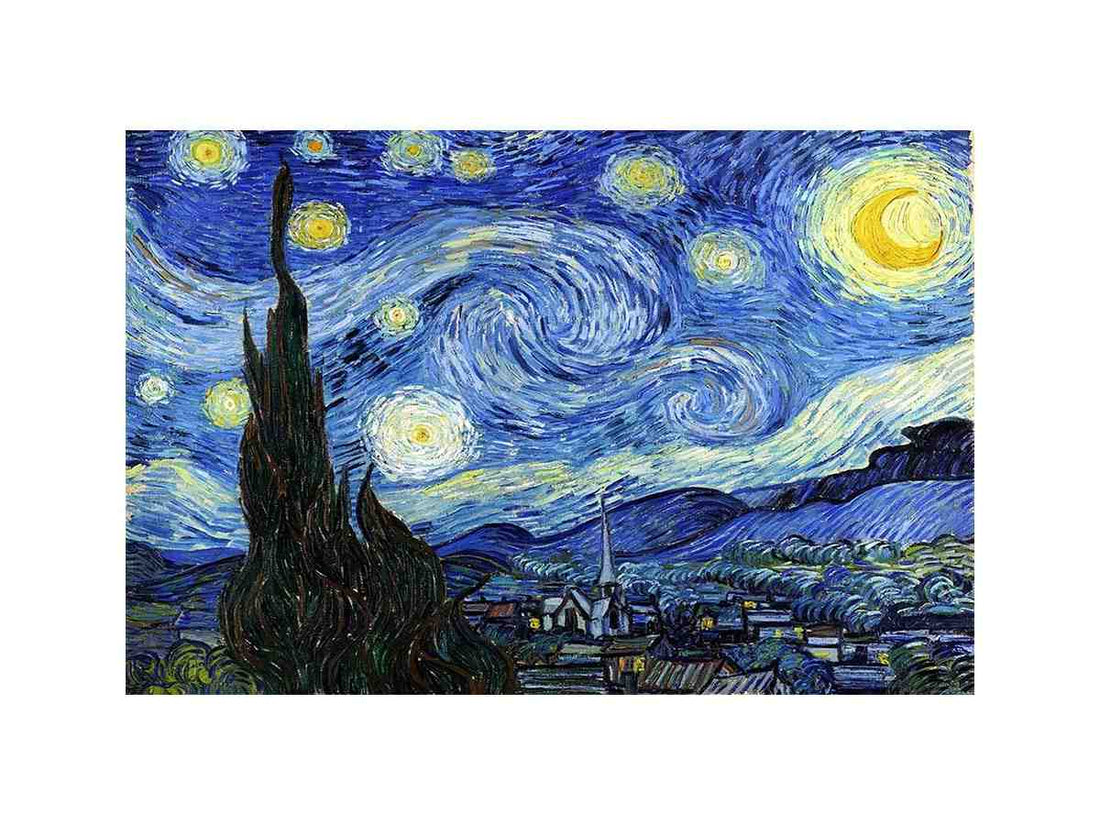
Capturing the Physical Layers of The Starry Night
In The Starry Night, Van Gogh’s swirling ultramarine sky formations and luminous yellow celestial movements rely on thick impasto layering to create motion and emotional atmosphere.
High-resolution fine art scanning allows premium canvas reproductions to preserve subtle paint ridges, tonal layering, and visible directional brush movement that ordinary poster printing simply cannot replicate.
- Visible texture shadows
- Paint depth simulation
- Pigment density variation
- Enhanced colour vibration
- Improved atmospheric depth
“To properly reproduce Van Gogh’s layered impasto brushwork, the artwork requires heavy 400–450 GSM museum-grade canvas and archival pigment inks capable of preserving subtle texture depth and colour movement.”
Van Gogh’s Colour Theory & Emotional Expressionism
Van Gogh’s emotional power came not only from brushwork, but also from his revolutionary use of complementary colour contrast and chromatic intensity.


Why Museum-Grade Canvas Matters for Van Gogh Prints
Van Gogh reproductions benefit enormously from premium material quality because the paintings depend on visible texture, chromatic richness, and dimensional depth.
| Standard Poster Print | Premium Museum-Grade Canvas |
|---|---|
| Flat visual appearance | Enhanced painterly dimensionality |
| Limited pigment depth | Rich archival pigment absorption |
| Minimal texture interaction | Canvas texture mimics painted surfaces |
| Weak emotional atmosphere | Immersive visual movement & warmth |
The Importance of 400–450 GSM Canvas
Heavy museum-grade canvas absorbs archival pigment inks more deeply, preserving tonal transitions, subtle texture shadows, and layered brush movement in a way lightweight canvas cannot achieve.

Why Van Gogh Works Beautifully in Australian Homes
Van Gogh’s emotionally expressive colour palettes pair exceptionally well with contemporary Australian interiors featuring warm neutrals, eucalyptus greens, earthy clay palettes, and organic modern styling.
In open-plan Australian homes with abundant coastal daylight, the textured surface of premium canvas reproductions creates subtle dimensional shifts throughout the day.
- Perfect for oversized statement walls
- Enhances organic contemporary interiors
- Softens minimalist architecture
- Adds emotional warmth to modern homes
Frequently Asked Questions
What is Van Gogh’s impasto technique?
Impasto is a painting technique where thick layers of oil paint are applied directly onto the canvas, creating visible texture and sculptural brushwork.
Why do Van Gogh paintings work well as canvas prints?
Van Gogh’s paintings rely heavily on visible texture, colour vibration, and painterly depth, making museum-grade canvas reproductions significantly more immersive than flat poster prints.
What canvas quality is best for Van Gogh reproductions?
Heavy 400–450 GSM museum-grade canvas combined with archival pigment inks provides the best reproduction quality for preserving texture depth and colour richness.
Do Van Gogh prints suit modern Australian interiors?
Yes. Van Gogh’s emotional colour palettes and painterly textures pair beautifully with warm neutral interiors, organic contemporary styling, and open-plan Australian homes.